
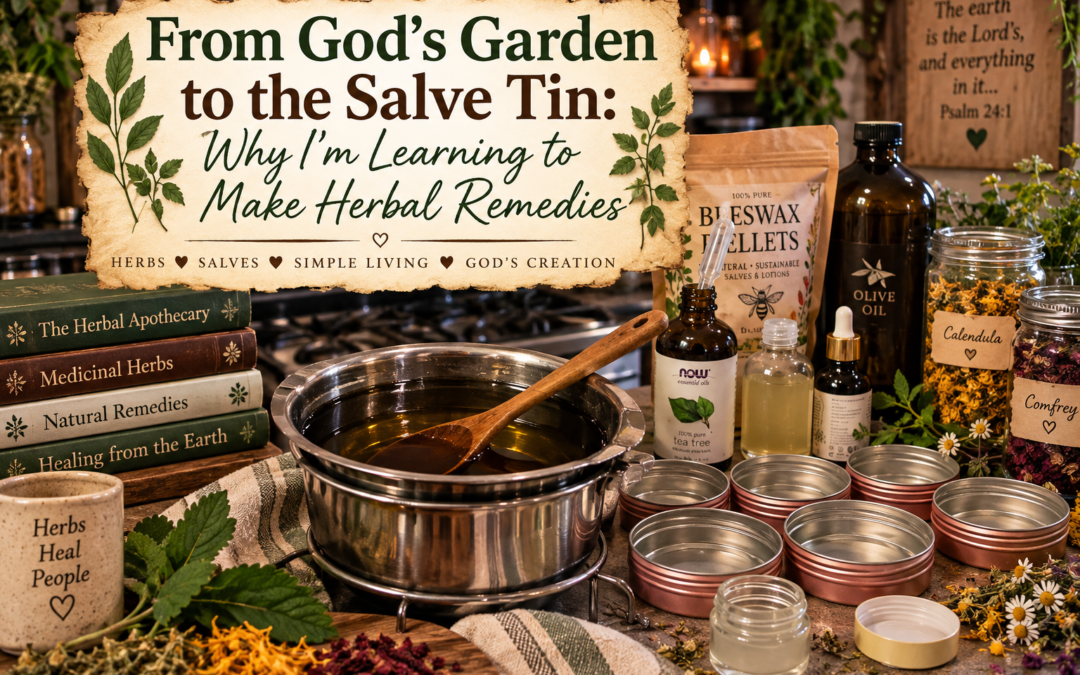
🌿 From God's Garden to the Salve Tin: Why I'm Learning to Make Herbal Remedies
If you had told me years ago that I'd get this excited about a jar full of “weeds” soaking in oil, I probably would've laughed at you. 😂
But here we are.
My kitchen recently turned into a full-blown little home apothecary. I had herbs infusing, oils straining, beeswax melting, essential oils everywhere and little metal tins lined up waiting to be filled.
By the end of the day, I had 32 tins of homemade salves and balms ready for the upcoming harvest festivals at Gilby's Orchard. 🌿🍎
And somewhere in the middle of all that mess, I found myself thinking about how incredible God's creation really is.
“The earth is the Lord's, and everything in it…” — Psalm 24:1
Plants like dandelion, plantain and goldenrod grow all around us. We mow over them, pull them out of gardens and call them weeds.
Yet generations before us knew these plants very differently.
They gathered them. They dried them. They infused them into oils. They made teas, poultices, tinctures and salves.
And now modern researchers are taking many of these same plants into laboratories and asking:
“What's actually inside this plant, and what does it do?”
I LOVE that.
I don't see science and faith fighting against each other here.
For me, studying the plant gives me another opportunity to marvel at the One who created it.
🌿 Why I'm Learning Herbalism
I'm not a doctor, pharmacist or scientist.
I'm learning.
I'm a woman who became interested in taking better care of the body God gave me and started asking questions.
What's actually in the products I'm putting on my skin?
What did people use before our bathroom cabinets became filled with manufactured products?
Why have certain plants been used by herbalists for hundreds—or thousands—of years?
And perhaps most interestingly:
What does modern research say about them now?
That's what I want this part of Sharla's Wanderlust Adventures to be about.
I don't want to blindly believe something just because someone on the internet says it's natural.
But I also don't want to automatically dismiss generations of herbal knowledge because something grew in the backyard instead of coming out of a factory.
I want to learn.
And as I learn, I want to share it with you.
🌿 First Things First: How Do I Make Herbal-Infused Oil?
If you've never made an herbal oil before, don't let the word “infusion” intimidate you.
You're basically letting dried herbs sit in a carrier oil so some of the oil-soluble components of the plant can move into that oil.
There are two ways I do it.
🌿 Method #1: The Slow Infusion
This is the easiest method if you're not in a hurry.
I put my dried herbs into a clean, completely dry Mason jar and cover them thoroughly with my carrier oil.
I make sure all the herbs are saturated and submerged, close the jar and label it with what I put inside and the date.
Then...
I wait. 😂
I put the jar somewhere cool and dark, such as a cabinet, and let it infuse for approximately 4–8 weeks. I'll gently turn or shake the jar periodically to redistribute everything.
When I'm happy with the infusion, I pour everything through a fine-mesh strainer lined with cheesecloth.
Then comes my favorite part:
SQUEEZE that cheesecloth! 😂
There's still a surprising amount of beautiful herbal oil hiding in those herbs.
Once I've strained out the plant material, I have my herbal-infused oil.
I can use it immediately to make a salve or transfer it into a dark glass bottle, label it and store it somewhere cool and dark until I'm ready to use it.
🔥 Method #2: My Gentle-Heat Method
Sometimes I don't want to wait six weeks.
That's where gentle heat comes in.
I put my dried herbs and carrier oil into a heat-safe glass jar and place that jar into a water bath on the stove, essentially creating a little double boiler.
You can also use the top of an actual double boiler.
The key words here are:
LOW and SLOW.
I'm not frying the herbs.
I'm not boiling the oil.
I'm simply keeping everything gently warm so the infusion happens faster.
I keep an eye on the water level, make sure water doesn't get into my oil, and periodically turn the heat off when necessary rather than letting the herbs get too hot.
Depending on what I'm making and how much time I have, I'll gently warm the infusion for several hours or do repeated periods of very low heat.
Then I let everything cool and strain it exactly as I would with the slow method.
The little double boiler I use
And yes, it's little. 😂
But it got me through 32 tins!
🌿 One important note
For these long oil infusions, especially if you're new to herbalism, start with properly dried herbs rather than freshly picked wet plant material.
Water and oil don't play nicely together when we're trying to make something shelf-stable. Moisture trapped in plant material can encourage unwanted microbial growth or spoilage.
Fresh herbs have their place—like when I grab fresh plantain for immediate personal use—but that's different from putting wet herbs into a jar of oil and storing it for weeks.
🌿 Dried Herbs or Essential Oils—Which Do I Use?
This confused me when I first started learning.
Do I need lavender flowers?
Lavender essential oil?
Both?
The answer is:
It depends on what I'm making!
I can take dried lavender flowers, cover them with a carrier oil and make a lavender-infused oil.
Or I can make a plain carrier-oil-and-beeswax balm and add an appropriately diluted amount of lavender essential oiltoward the end.
Sometimes I use both.
They're not identical preparations.
Essential oils are extremely concentrated aromatic extracts containing the plant's volatile compounds.
An herbal-infused carrier oil extracts a different mixture of compounds from the whole plant.
That's why a recipe may use cups of herbal-infused carrier oil but only drops of essential oil.
More essential oil isn't necessarily better.
For example...
🌿 Lavender flowers can be infused into a carrier oil.
💧 Lavender essential oil can be added in small amounts to a finished formulation.
🌿 Peppermint leaf can be used for an herbal infusion.
💧 Peppermint essential oil is dramatically more concentrated and gives you that powerful peppermint aroma and cooling sensation with only a small amount.
🌿 Eucalyptus leaf can be infused into an oil.
💧 Eucalyptus essential oil gives you the highly concentrated aromatic preparation.
Neither method is automatically “better.”
They're simply different tools for different preparations.
🌿 MY SKIN BALM
This one began long before I turned on my double boiler.
I made an herbal-infused oil using:
Goldenrod + Plantain + Dandelion
After those herbs had infused, I strained them and used that beautiful herbal oil as the foundation of my balm.
My Recipe
1 cup goldenrod, plantain & dandelion infused oil
2 Tbsp castor oil
2 Tbsp unrefined shea butter
2 Tbsp cocoa butter
2 Tbsp beeswax
1 tsp vitamin E oil
25 drops frankincense essential oil
15 drops myrrh essential oil
15 drops tea tree essential oil
And let me tell you—the cocoa butter was a GOOD decision. 😂
It gives the balm a slight natural chocolatey smell while the shea butter makes everything wonderfully creamy.
🌱 Plantain — The Little “Weed” That Changed My Perspective
Plantain was one of the plants that really opened my eyes to herbalism.
And I'm not talking about the banana-looking plantain.
I'm talking about that little green plant growing in lawns, fields, trails and probably somewhere near your driveway.
People have traditionally used fresh plantain leaves as poultices and dried plantain in herbal preparations.
But my interest didn't start with a research paper.
It became personal.
🌿 My Friend's Plantain Story
A friend of mine was actually outside picking plantain from her yard when her husband came around the corner with a weed whip.
He accidentally caught her hand.
The weed whip went across all four fingers, and she told me three wounds were so deep that bone was visible.
She placed fresh plantain leaves over her fingers and wrapped them.
When she removed everything approximately two days later, she told me she couldn't believe what she saw. What was visibly left was primarily scabbing.
Now...
If you can see your BONE, please go get medical attention! 😳😂
I'm sharing her experience—not recommending that someone else make the same medical decision.
But you can probably imagine why hearing that made me ask:
WHAT is in this little plant?!
Then I had an experience of my own.
😬 The Day I Pressure-Washed My Hand
I borrowed my neighbor's pressure washer to clean some large plastic storage bins.
I was holding one upright while spraying it when I accidentally caught the entire back of my hand.
OH. MY. GOODNESS.
That hurt.
I didn't run for my salve.
I ran into the woods looking for plantain. 😂🌿
I found fresh plantain leaves and placed them directly over the area.
And that's an important distinction in how I personally use plantain.
If I have an open wound, I don't put my finished salves into it.
Once the skin has closed, that's when I personally begin using my salve externally.
With my pressure-washer injury, I used the fresh leaf first and my plantain salve later after the area had closed.
I was amazed by how quickly my hand appeared to recover.
That's my experience—not a promise about what someone else's body will do.
But between my experience, my friend's experience, generations of traditional use and the scientific interest in plantain?
You better believe it earned a permanent place in my herbal cabinet. 😂
🌼 Goldenrod — Another Plant Hiding in Plain Sight
Goldenrod is another plant many of us have seen thousands of times without thinking much about it.
Those beautiful yellow flowers appear everywhere toward the end of summer.
Traditional herbalists have used goldenrod preparations for generations, and scientists have identified many natural compounds in the plant that continue to be studied.
Now when I see a field full of goldenrod, instead of seeing weeds, I think:
How much have we been walking past without ever bothering to learn about it?
🌼 Dandelion — Maybe We Should Stop Hating Our Lawns 😂
Poor dandelions.
People spend a fortune trying to kill them.
Meanwhile herbalists are collecting the flowers, leaves AND roots. 😂
Different portions of the plant contain different compounds and have histories of different traditional uses.
Dandelion represents so much of what I'm discovering:
Something isn't useless simply because somebody taught us to call it a weed.
🤎 Castor Oil — This One Is VERY Personal
Castor oil has become one of my favorite oils.
It's thick.
It's sticky.
And if you spill it, you're going to know it. 😂
But my relationship with castor oil goes much deeper than salve making.
❤️ Castor Oil & Our Cancer Journey
During my ex's cancer journey, we incorporated castor-oil packs externally over his liver as part of the natural-health practices we were using.
There's a much bigger testimony behind that season of my life, and I've written about it separately.
Read my cancer testimony and our experience with castor-oil packs
That's our personal testimony. I'm not saying castor oil cures cancer or telling someone to replace cancer treatment with castor-oil packs.
I'm telling you what we experienced and why it made me want to learn more.
🌿 My Own Experience With Ovarian Cysts
I also had two ovarian cysts at one point.
I began applying castor oil externally over the area.
When I was checked again less than a month later, the cysts were gone.
That's what happened to me.
Can I prove the castor oil made them disappear?
No.
Ovarian cysts can resolve on their own, so my experience alone can't tell us why they disappeared.
But did it make me even more interested in castor oil?
Absolutely.
There's room to say both:
“Here's what happened to me.”
and
“Here's what science can currently establish.”
🛒 What I Look for When Buying Castor Oil
I'm picky about my castor oil.
I personally look for:
✔ Cold-pressed
✔ Hexane-free
✔ Packaged in dark glass
Cold-pressed and hexane-free describe different processing characteristics, so I don't assume one automatically guarantees the other.
The dark glass is also something I prefer because it helps protect oils from light exposure.
🧈 Shea Butter + Cocoa Butter
These don't need a chemistry lesson.
Put them on dry skin and you'll understand why I love them. 😂
They're wonderfully rich plant butters that help soften and condition the skin while giving the balm its creamy consistency.
And unrefined cocoa butter naturally smells like chocolate.
Enough said. 😂🤎
But what I personally love buying is the bundle because I get shea butter + cocoa butter + mango butter together:
The shea, cocoa & mango butter bundle I buy
✨ Frankincense & Myrrh — Ancient Oils That Still Fascinate Me
These two are especially meaningful to me.
How can I be a Christian learning about herbs and oils and NOT get excited about frankincense and myrrh? ❤️
People have treasured these resins for thousands of years.
And of course, Christians immediately recognize them from Scripture:
“Then they opened their treasures and presented Him with gifts of gold, frankincense and myrrh.” — Matthew 2:11
Scientists are still studying compounds found in these ancient plants today.
There's even early human research involving specific Boswellia-derived compounds and aging skin, including fine lines, roughness and elasticity.
That doesn't mean the frankincense essential oil in my bottle has been proven to erase wrinkles. The preparation studied wasn't the same thing.
But the fact that researchers are still studying a resin valued thousands of years ago?
I find that fascinating.
Frankincense essential oil I use
🌿 Tea Tree — One Mighty Little Bottle
Tea tree is one of those essential oils I like keeping around.
Research has demonstrated antimicrobial activity—including antibacterial and antifungal activity—particularly in laboratory studies.
In regular English?
There really are reasons tea tree has developed such a reputation as a cleansing botanical.
That doesn't mean a bottle of tea tree oil cures every infection.
But it does mean scientists have observed some of the properties people associate with it.
And remember:
Essential oils are concentrated.
More isn't better.
I dilute mine into much larger oil-based formulations.
🐝 Beeswax — What Turns My Oil Into a Salve
At its simplest:
Herbal-infused oil + beeswax = salve.
The beeswax gives liquid oil structure.
More beeswax = firmer salve.
Less beeswax = softer balm.
Add plant butters and you can change the consistency even more.
🌿 MY MUSCLE & JOINT BALM
This one took patience because I made the herbal oil first.
My infusion contained:
Plantain + Calendula + Comfrey + St. John's Wort + White Willow Bark
Then for each batch I used:
1 cup infused herbal oil
¼ cup castor oil
¼ cup + 1 Tbsp beeswax
1 Tbsp vitamin E oil
30 drops frankincense
20 drops myrrh
15 drops tea tree
See how I made my Muscle & Joint Herbal Balm here
🌼 Calendula — A Salve-Maker's Favorite
Calendula is gorgeous.
Those bright orange and yellow flowers have been used in traditional skin preparations for generations.
And researchers have studied calendula preparations in humans for different kinds of skin and wound care.
Some results are encouraging.
Some are mixed.
And that's okay.
An herb doesn't have to be magic for me to appreciate it.
I want to know what generations before us observed, what scientists are discovering and what questions we still haven't answered.
🌼 Arnica — What I'm Adding to My NEXT Batch!
Here's something that happened while I was researching this article.
I found another herb I want in my muscle balm. 😂🌿
ARNICA!
Arnica has a long history of external herbal use, especially in preparations intended for sore, overworked areas of the body.
And unlike some herbs where most of the evidence is still in the laboratory, specific topical arnica preparations have actually been studied in humans for things including osteoarthritis and muscle soreness.
So although arnica is NOT in the batch pictured in this article, I already know I'm going to include it when I make my next herbal infusion for my muscle balm.
That's part of why I'm sharing this journey.
I'm still learning too!
Arnica I bought for my next batch
Important: Arnica is generally used externally and shouldn't be applied to broken skin. Don't eat the dried arnica I'm linking here.
🌿 Comfrey — AKA “Knitbone”
I LOVE learning the old names for herbs.
Comfrey was traditionally called “knitbone.”
You can probably guess why herbalists valued it. 😂
What's especially interesting is that researchers eventually started studying topical comfrey preparations too.
There have been human clinical trials involving specific comfrey-root preparations and musculoskeletal complaints.
Does that mean my homemade comfrey infusion is identical to a standardized clinical product?
No.
But think about how fascinating this is:
Generations of traditional knowledge eventually led researchers back to the same plant.
🌿 St. John's Wort
Most people hear St. John's wort and think about supplements.
But herbalists have also traditionally made St. John's wort-infused oils for external use.
And here's something else I appreciate about researching herbs:
Not every study comes back saying something works wonderfully.
Sometimes the answer is:
“We don't know yet.”
Or:
“That particular study didn't find a difference.”
That's okay!
I'm not interested in pretending every natural ingredient is miraculous.
I'm interested in learning what we actually know.
🌳 White Willow Bark — Where Herbal History Gets REALLY Interesting
Willow bark contains naturally occurring salicin-related compounds.
Research involving willow and salicylates became part of the history that eventually led to modern aspirin.
Think about that.
People were using a TREE long before anybody could explain its chemistry.
Eventually scientists started asking:
“Why?”
That's one of the things I find so fascinating about herbalism.
Traditional knowledge and modern science aren't always living on two different planets.
Sometimes modern science circles right back around and starts investigating what people observed generations ago.
🌙 GET SOME Z'S BEDTIME SALVE
Okay.
This one just smells GOOD. 😂💕
I wanted something aromatic that I could rub onto my skin as part of winding down in the evening.
My Recipe
1 cup + 1 Tbsp sweet almond oil
¼ cup coconut oil
4 Tbsp beeswax
Then:
15 drops lavender
10 drops frankincense
8 drops Zen essential-oil blend
4 drops rose geranium
The lavender comes through first, followed by the warmer scent of frankincense and the Zen blend, with just enough rose geranium to add a soft floral note.
💜 Lavender — There's a Reason Everyone Associates It With Bedtime
Lavender and bedtime just seem to belong together.
And interestingly, researchers have actually studied lavender aromatherapy and sleep in humans.
The research is encouraging enough that I find it fascinating—but no, lavender isn't magical sleepy-time fairy dust. 😂
For me, I simply love incorporating that familiar aroma into my nighttime routine.
And remember what we talked about earlier:
You have options.
or
Dried lavender flowers for infusing
🌹 Rose Geranium
A LITTLE of this goes a long way.
Too much and my bedtime salve would've smelled like Grandma's perfume drawer. 😂
But just a few drops gave it exactly the soft floral note I wanted.
Geranium aroma has even made its way into human research involving relaxation and anxiety.
Interesting?
Absolutely.
A magic potion?
No. 😂
Rose geranium essential oil I use
🌬️ BREATHE EASY COOLING CHEST RUB
I wanted that familiar cooling, aromatic chest-rub experience while knowing exactly what I put into mine.
Adult Recipe
¾ cup coconut oil
½ cup beeswax
30 drops peppermint
50 drops eucalyptus
20 drops tea tree
14 drops lavender
This one smells AMAZING.
You immediately get that cool peppermint/eucalyptus aroma.
🌿 Why Does Peppermint Feel Cold?
This is one of those pieces of science that's actually fun.
Peppermint contains menthol.
Our bodies have receptors that detect temperature, and menthol activates some of the same cold-sensing signals.
So when peppermint touches your skin and your brain says:
“WHOA—that's cold!”
You're not imagining it. 😂
That's your nervous system responding to menthol.
See?
Science doesn't have to sound like another language.
You can work with peppermint in different ways depending upon your preparation:
🌿 Eucalyptus
Eucalyptus gives chest preparations that unmistakable fresh aroma.
Open the bottle and there's absolutely NO wondering what you're smelling. 😂
Again, I keep both forms around:
There are also different species of eucalyptus, and they aren't identical—which becomes especially important when we're making something intended for children.
See how I made my "Breathe Easy Cooling Chest Rub" here
👧 BREATHE EASY KIDS — AGES 3+
I didn't take my adult recipe and slap a children's label on it.
My children's formulation is intentionally much gentler.
Kids Recipe
1 cup coconut oil
½ cup beeswax
20 drops lavender
12 drops Eucalyptus radiata
4 drops peppermint
That's dramatically less peppermint and eucalyptus than my adult formulation.
I label mine AGES 3+, external use only, and don't recommend applying it on or near a child's face or nose.
Essential oils are concentrated.
More isn't better.
That's one of the most important lessons I've learned.
🛒 Want to Start Making Your Own Herbal Salves?
You really don't need a fancy setup.
Trust me.
You should see the size of my double boiler. 😂
Here are some of the tools I use:
- Mason jars for infusing
- Fine-mesh strainer
- Cheesecloth
- Small double boiler
- Measuring cups & spoons
- Droppers/pipettes
- 2-ounce tins
- Brown glass bottles with droppers
And if you'd rather browse everything in one place:
🌿 SHOP MY HERBAL APOTHECARY
I've gathered the herbs, oils, essential oils and supplies I use there so you don't have to hunt everything down individually.
😂 Apparently Paper Towels Are Optional
One unexpected discovery from making 32 tins?
Every time I strained oil and had some left on my hands...
Onto my arms it went.
Spilled some almond oil?
Rub it in.
Castor oil left on the spoon?
I'm not wasting THAT.
Shea butter on my fingers?
Might as well moisturize. 😂
By the end of the day I'd rubbed so many different oils and butters into my arms, hands and face that my skin felt ridiculously soft.
Apparently my first customer was me. 😂🌿
❤️ A Little Common Sense Before You Raid the Backyard
I LOVE learning about natural remedies.
But natural doesn't mean we throw common sense out the window.
Correctly identify plants before using them.
For stored oil infusions, I prefer properly dried herbs.
Essential oils are highly concentrated and need appropriate dilution.
Some plants can cause allergic reactions or interact with medications.
Pregnancy, breastfeeding, health conditions and children's ages can change what's appropriate.
And please remember my friend's story:
If you can see your bone, GO TO THE HOSPITAL. 😂
Likewise, significant pressure-washer injuries deserve medical evaluation because the damage can sometimes extend deeper than it appears.
I can tell you what I do.
I can tell you what I've experienced.
I can tell you what people have traditionally done.
And I can show you what researchers have actually studied.
Then you can keep learning too.
🌿 The More I Learn About Creation, the More I Marvel at the Creator
This is really the heart behind all of it for me.
Every time I research another plant, I find myself thinking:
God thought of ALL of this.
A little plant growing unnoticed beside the driveway can contain compounds researchers spend years studying.
A flower has chemistry.
Tree bark has chemistry.
Resin dripping from a tree has chemistry.
And none of that takes God out of the picture for me.
It makes me marvel at Him even more.
“Through Him all things were made; without Him nothing was made that has been made.” — John 1:3
I'm learning to look differently at the world around me.
Instead of seeing weeds...
I'm asking what they are.
Instead of automatically buying another product...
I'm asking whether I can learn to make it.
Instead of automatically accepting everything I'm told—from either side...
I'm researching it.
I'm learning from generations of traditional herbal knowledge.
I'm reading modern studies.
I'm experimenting carefully.
I'm praying.
And I'm asking God to show me how what I'm learning can be used to help other people.
Maybe that's part of what Sharla's Wanderlust Adventures was always supposed to become.
Not only exploring beautiful places.
But exploring God's creation itself.
🌿✝️❤️
🍎 Come See Me at Gilby's Orchard!
If you're in Minnesota, come see some of these creations in person!
I'll be bringing my handmade salves and balms to the upcoming Gilby's Orchard Harvest Festival, along with teas, homemade baking mixes, seasonings and all the other goodies I'm still frantically trying to finish. 😂🍂
You can find current festival information on the Gilby's Orchard website or follow Gilby's Orchard on Facebook.
Come find the Sharla's Wanderlust Adventures booth and say hello!
I'd LOVE to meet you.
And if you're interested in learning how to make your own herbal preparations, stick around.
Because I'm definitely not finished learning.
I'll take you along for the adventure. 🌿💕
📚 For My Fellow Research Nerds
I promised I wasn't going to make you read a medical journal just to learn how I make a salve. 😂
But I DO believe in checking the research.
So this section is for anyone who wants to dig deeper.
I'll link studies and reputable references for:
- Plantain (Plantago major)
- Human randomized clinical trial of topical plantain for stage-1 pressure injuries: Plantago major clinical trial
- Systematic review of plantain and wound healing in preclinical studies: Plantago major wound-healing review
- Goldenrod
- Broad review of goldenrod’s traditional uses, plant compounds, and pharmacology: Goldenrod research review
- This one is especially useful because it plainly says most evidence is still non-clinical, which helps us explain the research honestly.
- Dandelion
- Recent review covering dandelion’s active plant compounds and pharmacological research: Dandelion research review
- Another broad review focused on phytochemistry and pharmacological activity: Dandelion phytochemistry review
- Castor oil
- Recent safety review describing castor oil as commonly functioning as a skin-conditioning ingredient in cosmetics: Castor oil cosmetic safety review
- For your ovarian-cyst and cancer stories, I would not attach a study claiming castor oil treats either condition, because I didn’t find solid human evidence establishing that. Those stay clearly labeled as your personal testimonies.
- Frankincense / Boswellia and aging skin
- This is the strongest one for the anti-aging discussion: a randomized, double-blind study of a boswellic-acid cream found improvements in fine lines, roughness and skin elasticity after 30 days. Boswellic acids and photoaged skin study
- A second record of that same clinical work gives more detail on photo- and age-damaged skin: Boswellic acid skin-aging study details
- Important wording for the blog: this research studied boswellic acids from Boswellia resin in a cream, not frankincense essential oil itself.
- Myrrh
- Laboratory research showing antimicrobial activity of myrrh oil against bacteria: Myrrh antimicrobial study
- Another study testing myrrh essential oil and extracts against bacterial strains: Myrrh bactericidal research
- These are useful for talking about laboratory antimicrobial findings, but I would not call myrrh clinically proven anti-aging based on what I found.
- Tea tree oil
- Study demonstrating antimicrobial activity against bacteria, fungi and other microorganisms in lab testing: Tea tree antimicrobial study
- Literature review noting antiseptic, antibacterial and antifungal activity while also discussing skin irritation risk: Tea tree antibacterial and antifungal review
- NCCIH’s reader-friendly overview of tea tree oil and the limits of the clinical evidence: NCCIH: Tea Tree Oil
- Calendula
- 2019 systematic review examining animal and human wound-healing studies; results were encouraging in some areas and mixed in others: Calendula wound-healing systematic review
- An older systematic review is also useful for showing how the evidence developed over time: Earlier Calendula wound review
- Comfrey
- Excellent human trial: 120 people with acute upper or lower back pain; standardized comfrey-root ointment significantly outperformed placebo. Comfrey randomized back-pain trial
- Broader review of external comfrey use covering back pain, ankle injuries, abrasions and osteoarthritis: External comfrey clinical review
- Another useful overview connecting traditional use with modern clinical trials: Comfrey: tradition to clinical trials
- St. John’s Wort
- Recent randomized trial of topical St. John’s wort oil for pressure injuries. It did not find a significant difference versus saline, which makes it a good example of us sharing unfavorable research too: St. John's Wort topical randomized trial
- White willow bark
- Systematic review of willow-bark preparations for musculoskeletal pain. It found moderate evidence for standardized ethanolic willow-bark extracts in low-back pain, while evidence for other conditions was mixed. Willow bark systematic review
- We’ll make clear that these were standardized extracts, not your homemade topical infusion.
- Lavender
- Recent systematic review and meta-analysis of 11 randomized trials involving 628 adults found lavender essential-oil interventions were associated with improved sleep quality overall. Lavender and sleep meta-analysis
- Rose geranium
- Randomized, triple-blind placebo-controlled study of geranium aroma and anxiety: Geranium aromatherapy clinical trial
- Peppermint / menthol
- Great source for explaining why peppermint feels cold: TRPM8 is one of the body’s primary molecular sensors for cold and menthol. Menthol and the TRPM8 cold receptor
- Another very readable scientific review explains menthol’s cooling mechanism: Menthol pharmacology review
- For the kids’ chest rub safety section, NCCIH specifically warns against putting menthol-containing peppermint oil on the face of infants or young children because inhaled menthol can affect breathing. NCCIH: Peppermint Oil Safety
- Eucalyptus / eucalyptol
- Review of 1,8-cineole—also called eucalyptol, a major constituent of many eucalyptus oils—including respiratory research: Eucalyptol research review
- Another review discusses anti-inflammatory and respiratory research involving purified 1,8-cineole: 1,8-Cineole respiratory research
- Again, this is an important distinction: research on purified 1,8-cineole doesn't automatically prove an eucalyptus-containing homemade chest rub has the same clinical effects.
About the Stories & Research I Share
I share my personal experiences and testimonies because they're part of my story and part of what led me to investigate natural wellness.
They're not guarantees of what another person's body will do.
And when I discuss research, I'll try to make it clear whether scientists studied the whole herb, an extract, an essential oil, an isolated compound or a particular finished preparation—because those aren't necessarily interchangeable.
My goal isn't to tell you what you have to believe.
It's to encourage you to learn, research, ask questions and appreciate just how incredible God's creation really is. 🌿
✨ Grace, adventure, and faith along the journey
Sharla – Sharla’s Wanderlust Adventures
Don’t forget — go somewhere new, heal the way God designed, and glorify Him in the journey.
My Challenge to YOU: Go somewhere new, heal the way God designed, and give Him all the glory in all you do.
About Sharla
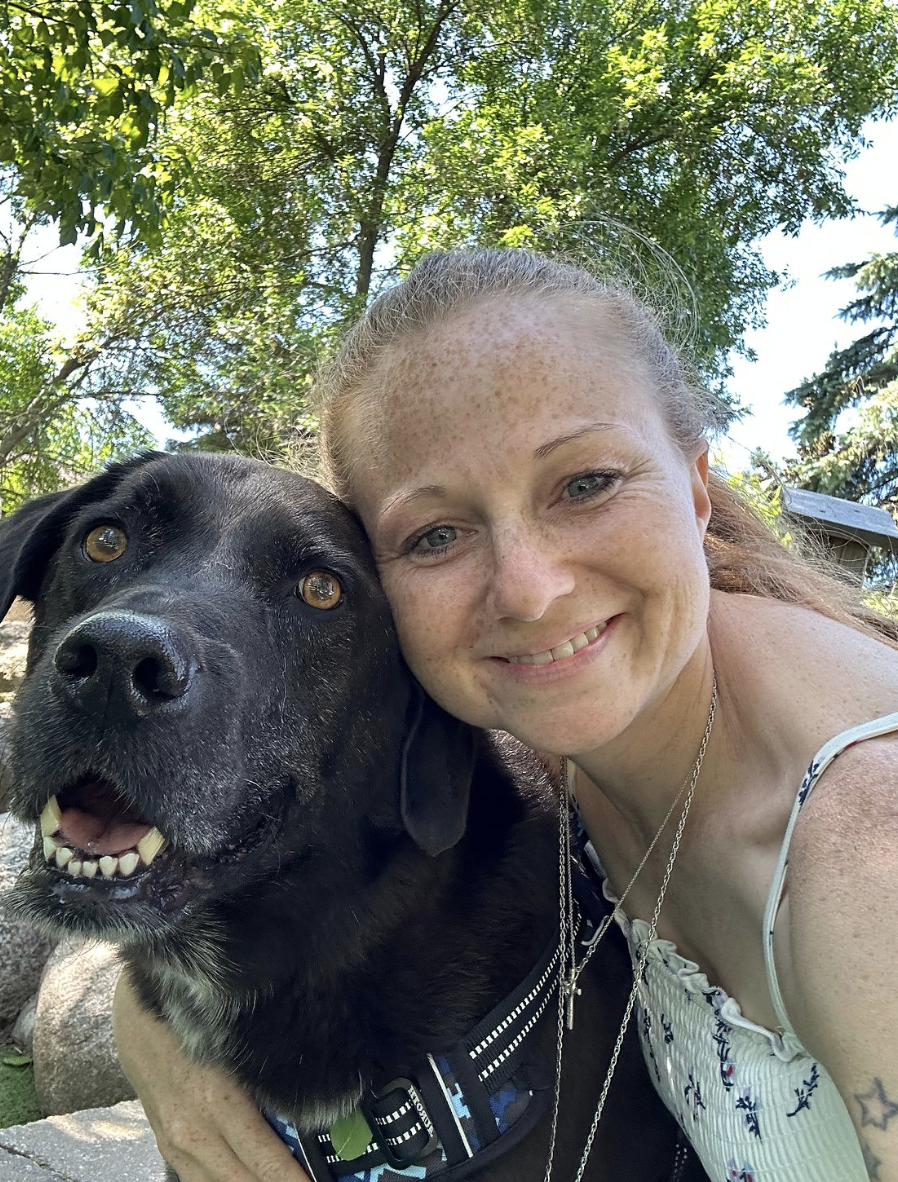
Hi, I'm Sharla—a veteran, traveler, empty nester, dog mom to Buster, and follower of Jesus. Through Sharla's Wanderlust Adventures, I share faith-filled travel experiences, Christian retreats, natural wellness, Bible studies, and the lessons God teaches me along the journey.
Affiliate Disclosure:
Sharla’s Wanderlust Adventures is reader-supported. When you purchase through links on this site, I may earn a small affiliate commission at no additional cost to you. I only share tools, resources, and products I’ve personally used, researched, or believe genuinely support healing.