
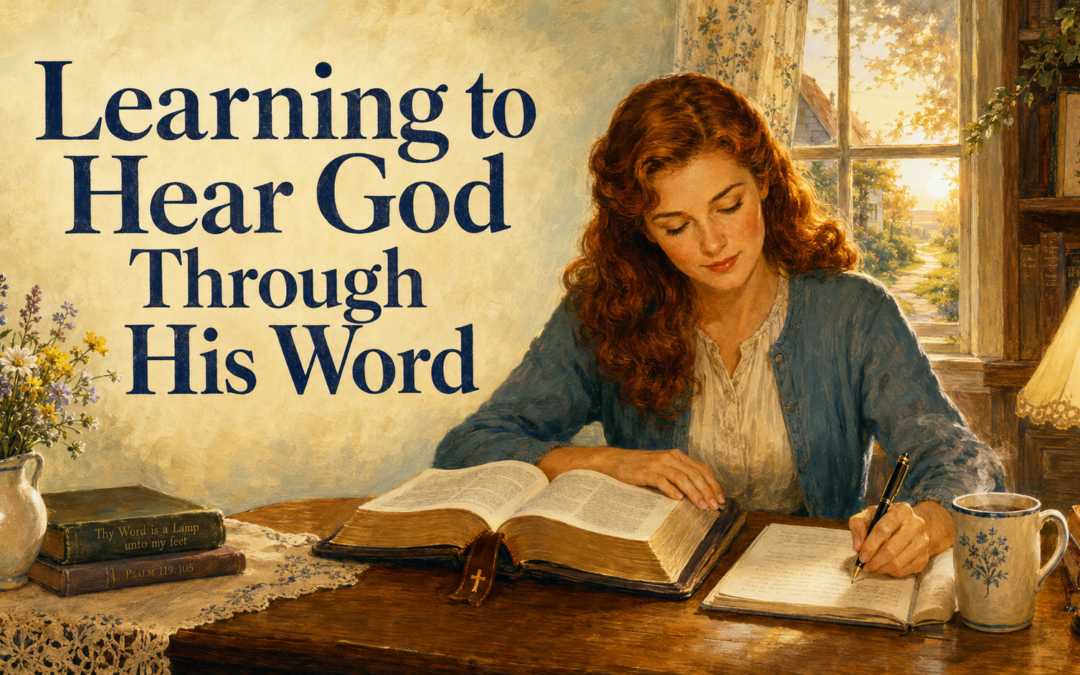
How Scripture helps us recognize God’s voice, discern His direction, and walk confidently in obedience
Have you ever wished God would simply speak out loud and tell you exactly what to do?
I certainly have.
There have been seasons when I desperately wanted God to show me which direction to take, whether I should move forward, and what He was doing while I waited. I have prayed, searched for answers, and sometimes wondered:
Was that thought from God—or was it only me?
What if I misunderstand Him?
How can I know whether God is really speaking?
Learning to recognize God’s voice has been an ongoing journey for me. But one truth has become foundational:
The more time I spend in God’s Word, the more clearly I recognize His voice.
God may guide us through the Holy Spirit, prayer, circumstances, wise counsel, or a quiet prompting within our hearts—but His direction will always agree with the truth He has already revealed in Scripture.
If we want to learn what God sounds like, we must first learn what God has said.
“Your word is a lamp to my feet and a light to my path.”
—Psalm 119:105
God Still Speaks to His Children
Throughout Scripture, we see a God who communicates with His people. He called Abraham, spoke with Moses, guided David, instructed the prophets, and led the early Church through the Holy Spirit.
Jesus also described His followers as sheep who know the voice of their Shepherd:
“My sheep hear My voice, and I know them, and they follow Me.”
—John 10:27
This verse gives me so much comfort. Jesus doesn’t say that only pastors, Bible scholars, or exceptionally spiritual people can recognize His voice. His sheep hear Him.
If you belong to Jesus, you can grow in recognizing His voice.
That doesn’t mean every thought in our minds comes from God. Our thoughts can be influenced by our emotions, fears, desires, past experiences, other people, and the enemy’s lies. That is why discernment matters—and why Scripture must remain our foundation.
God’s Word Is His Voice in Written Form
Sometimes we say that we wish God would speak to us while our Bibles remain closed beside us.
Yet Scripture is not merely a collection of ancient stories or encouraging sayings. It is God-breathed truth.
“All Scripture is given by inspiration of God, and is profitable for doctrine, for reproof, for correction, for instruction in righteousness.”
—2 Timothy 3:16
The Bible reveals God’s character, His heart, His promises, His commands, and His redemptive plan. It teaches us what He loves, what He opposes, and how He calls His children to live.
We should never believe that the written Word is somehow less personal than another kind of spiritual experience. When Scripture convicts, corrects, comforts, or directs us, God is speaking through the truth He has already given.
“For the word of God is living and powerful, and sharper than any two-edged sword.”
—Hebrews 4:12
I have read familiar passages during difficult seasons and suddenly felt as though those words were written specifically for what I was facing. The verse itself had not changed—but the Holy Spirit used it to reveal something my heart needed at that exact moment.
That is one of the beautiful ways God speaks through His Word.
The Holy Spirit Helps Us Understand Scripture
Before Jesus went to the cross, He promised that the Holy Spirit would teach and guide His followers.
“But the Helper, the Holy Spirit, whom the Father will send in My name, He will teach you all things.”
—John 14:26
The same Holy Spirit who inspired Scripture helps believers understand and apply its truth. This is why prayer is such an important part of Bible reading.
Before opening the Bible, we can pray:
Lord, quiet my thoughts and help me hear You. Give me wisdom and understanding. Show me what this passage reveals about You, what You want to change in me, and how You want me to respond.
We aren’t asking God to make the Bible mean whatever we want it to mean. We are asking Him to help us understand what He intended and to show us how that truth applies to our lives.
“Open my eyes, that I may see wondrous things from Your law.”
—Psalm 119:18
Hearing God Begins With Knowing His Character
Imagine receiving a message that claimed to be from someone you loved deeply. You would likely recognize whether it sounded like that person because you know their character, their language, and the way they communicate.
Our relationship with God grows similarly.
The more we study Scripture, the more familiar we become with His character. We learn that He is holy, loving, merciful, truthful, patient, just, faithful, and compassionate. We see that He never contradicts Himself and never leads us into sin.
As we become familiar with the truth, counterfeits become easier to recognize.
God’s voice may convict us, but He does not crush us with hopeless condemnation. Conviction identifies something specific and draws us toward repentance and restoration. Condemnation declares that we are worthless, beyond forgiveness, and should hide from God.
Scripture teaches us:
“There is therefore now no condemnation to those who are in Christ Jesus.”
—Romans 8:1
God may call us outside our comfort zones, but He will not direct us to violate His Word. He may ask us to surrender something, wait longer than we would prefer, forgive someone, or take a step requiring faith. But His direction will remain consistent with His nature.
How Can I Know Whether a Thought Is From God?
When I sense a prompting or direction, I have learned not to act on emotion alone. I bring it before the Lord and test it.
1. Does it agree with Scripture?
God will never contradict His written Word.
He will not tell us to be dishonest, seek revenge, participate in sin, mistreat someone, or abandon biblical truth. If a message conflicts with Scripture, we do not need another sign. It is not from God.
“To the law and to the testimony! If they do not speak according to this word, it is because there is no light in them.”
—Isaiah 8:20
This also means we must study entire passages rather than pulling isolated verses out of context to support something we already want.
2. Does it reflect the character of Jesus?
God’s leading will produce qualities consistent with the Holy Spirit:
“But the fruit of the Spirit is love, joy, peace, longsuffering, kindness, goodness, faithfulness, gentleness, self-control.”
—Galatians 5:22–23
That does not mean every instruction will feel easy or comfortable. Obedience can be difficult. But God’s direction will never require us to become cruel, manipulative, prideful, or deceptive.
3. Is it conviction or condemnation?
The Holy Spirit brings specific conviction that leads us back to God. The enemy uses vague shame to make us withdraw from Him.
God may say, in effect, This behavior is hurting you. Confess it, surrender it, and let Me change you.
Condemnation says, You always fail. God is tired of you. There is no point in trying.
One produces repentance and freedom. The other produces shame and isolation.
“For godly sorrow produces repentance leading to salvation, not to be regretted; but the sorrow of the world produces death.”
—2 Corinthians 7:10
4. Have I prayed instead of rushing?
I have learned that not every decision requires an immediate response. Sometimes wisdom means slowing down, praying, and allowing God to confirm the next step.
“If any of you lacks wisdom, let him ask of God, who gives to all liberally and without reproach.”
—James 1:5
Fear and pressure often shout, You have to decide right now! God is fully capable of guiding us without manipulating us through panic.
5. Can it be confirmed through godly counsel?
God can use mature believers to help us recognize something we are missing.
“Where there is no counsel, the people fall; but in the multitude of counselors there is safety.”
—Proverbs 11:14
Counsel should never replace prayer or Scripture, and popular opinion is not always godly wisdom. But trustworthy believers who know God’s Word can help us test our interpretation.
6. Am I willing to obey if God’s answer is not what I want?
This may be the most difficult question.
Sometimes we are not truly asking God for direction—we are asking Him to approve the decision we have already made.
A surrendered heart prays:
Lord, I want Your will more than I want my way. Show me the truth, even if it requires waiting, changing direction, or releasing something I love.
“Trust in the Lord with all your heart, and lean not on your own understanding; in all your ways acknowledge Him, and He shall direct your paths.”
—Proverbs 3:5–6
7. Does it bring God’s peace and clarity—or confusion and anxious pressure?
Scripture tells us:
“For God is not the author of confusion but of peace.”
—1 Corinthians 14:33
When I am trying to discern God’s direction, I pay attention to what is happening within me. Am I experiencing a growing sense of peace and clarity as I pray—or am I being driven by confusion, overwhelming anxiety, worry, stress, and the feeling that I must decide immediately?
Fear and pressure often say:
You have to act right now.
You are going to miss your opportunity.
Everything will fall apart if you make the wrong choice.
God is fully capable of guiding us without manipulating us through panic.
If a decision continually leaves us overwhelmed, confused, and deeply unsettled, it may not be the right decision—or it may simply not be the right timing. Sometimes God’s answer is not no but not yet. He may be asking us to slow down, continue praying, gather wisdom, or wait until His direction becomes clearer.
“Let the peace of Christ rule in your hearts.”
—Colossians 3:15
The word rule carries the idea of acting like an umpire—helping determine what should be allowed to remain. God’s peace can serve as an important part of our discernment when it is joined with Scripture, prayer, wisdom, and surrender.
However, peace does not always mean that a decision will feel easy or comfortable. God sometimes calls us to do things that require courage: forgive someone, end an unhealthy relationship, step into an unfamiliar calling, have a difficult conversation, or move forward without knowing every detail. Jesus Himself experienced deep anguish before the cross, yet He remained surrendered to the Father’s will.
There is a difference between the nervousness we may feel when taking a courageous step of faith and the persistent chaos that comes from forcing something God has not confirmed.
God’s peace may exist beneath trembling hands. It may sound like:
I am nervous, and I don’t know exactly how this will unfold—but I believe this is the faithful next step, and I trust God to guide me.
When clarity has not come, we do not have to manufacture it. We can bring every concern to God and allow His peace to guard us while we wait:
“Be anxious for nothing, but in everything by prayer and supplication, with thanksgiving, let your requests be made known to God; and the peace of God, which surpasses all understanding, will guard your hearts and minds through Christ Jesus.”
—Philippians 4:6–7
God’s wisdom is “peaceable, gentle, willing to yield, full of mercy and good fruits” (James 3:17). His direction will never contradict Scripture, and He will not shame or terrorize us into obedience.
When confusion remains, I can pray:
Lord, I surrender this decision to You. Remove the pressure I am placing on myself and quiet every voice that is not Yours. If this is Your direction, please confirm it through Your Word and give me the peace and clarity to take the next step. If the answer is no—or not yet—help me wait without forcing an outcome. I trust You to guide me in Your timing.
Don’t Build Your Faith on “Signs” Alone
God can use circumstances to encourage or confirm us, but circumstances must be interpreted carefully.
When we are desperate for an answer, it can be easy to turn every coincidence, social media post, song, number, dream, or unexpected event into a personal message from God. But signs without Scripture can lead us into confusion.
The safest question is not merely, Did something unusual happen?
It is:
Does this agree with Scripture? Does it reflect God’s character? Has it been confirmed through prayer and wisdom?
We should also be careful about repeatedly asking God for new signs because we do not like the answer He has already given. Faith is not the endless pursuit of confirmation. At some point, faith requires trusting and obeying.
“For we walk by faith, not by sight.”
—2 Corinthians 5:7
What About When God Seems Silent?
There have been seasons when I prayed and searched Scripture but still did not know what God wanted me to do.
Silence does not mean abandonment.
Sometimes God has already given us enough light for the step directly in front of us. We want the entire plan, while He invites us to follow Him one day at a time.
A lamp does not illuminate an entire journey. It provides enough light for the next few steps.
God may use a season of waiting to deepen our trust, correct our motives, prepare circumstances we cannot yet see, or teach us to seek Him for who He is rather than only for the answers He can provide.
When I don’t know what God is doing, I can still obey what He has already made clear:
- Love God.
- Love others.
- Forgive.
- Pray.
- Serve.
- Give thanks.
- Remain faithful.
- Refuse fear.
- Continue doing the next right thing.
We don’t have to understand the entire plan to be obedient today.
“Wait on the Lord; be of good courage, and He shall strengthen your heart; wait, I say, on the Lord!”
—Psalm 27:14
Practical Ways to Hear God Through His Word
Read Scripture consistently
You do not need to read several chapters every day to have meaningful time with God. Begin with an amount you can read thoughtfully and consistently.
Even a short passage can become deeply meaningful when we slow down and pay attention.
Read the surrounding verses
Context protects us from accidentally making Scripture say something it does not say. Ask who wrote the passage, who received it, what was happening, and how it fits within the message of the whole Bible.
Write down what stands out
Keep a notebook or prayer journal nearby. Write down:
- What the passage reveals about God
- A promise to remember
- A command to obey
- A warning to consider
- Something to confess or surrender
- A question to study further
- A practical step you sense God asking you to take
Writing helps us slow down and notice patterns in what God is teaching us.
Pray Scripture back to God
Turning Scripture into prayer helps move truth from our minds into our hearts.
For example, after reading Proverbs 3:5–6, we might pray:
Lord, help me trust You with my whole heart. Forgive me for leaning on my limited understanding. I acknowledge You in this decision and ask You to direct my path.
Meditate on one passage
Biblical meditation is not emptying our minds. It is intentionally filling our minds with God’s truth.
Read a verse slowly. Repeat it. Write it down. Consider what each phrase means. Carry it with you throughout the day.
“But his delight is in the law of the Lord, and in His law he meditates day and night.”
—Psalm 1:2
Obey what God has already shown you
Recognizing God’s voice is connected to following Him.
If we constantly ask for new direction while ignoring what Scripture has already made clear, our spiritual hearing can become clouded. Obedience strengthens our discernment because it teaches us to respond when God brings truth to our attention.
“But be doers of the word, and not hearers only, deceiving yourselves.”
—James 1:22
Absolutely. I would replace the original section with this expanded version:
What If I Hear God Wrong?
This is a fear I understand deeply.
What if I take a step believing God is leading me and later realize I misunderstood Him? What if my desires, fears, or emotions influenced what I thought I heard? What if I make the wrong choice and somehow miss God’s plan?
I recently heard an encouraging sermon by Pastor Craig Groeschel called What If I Get It Wrong?. It reminded me of something I desperately need whenever I become afraid of making the wrong decision:
God’s plan is not so fragile that one imperfect choice can destroy it.
Ephesians 1:11 says that God “works out everything in conformity with the purpose of His will.” He is sovereign over the doors that open, the doors that close, our wise decisions, and even the poor choices He already knew we would make.
This does not mean every decision we make is God’s will or that our choices do not have consequences. God never approves of sin simply because He knew it would happen. But our failures do not surprise Him, overpower Him, or place us beyond His reach.
Psalm 139:16 tells us that all our days were written in God’s book before one of them came to be. He knew every choice we would make—and He chose to love us anyway.
God lovingly instructs and redirects us
God does not stand at a distance, waiting for us to make one wrong move. He remains close enough to instruct, counsel, correct, and redirect us.
“I will instruct you and teach you in the way you should go; I will counsel you with my loving eye on you.”
—Psalm 32:8
I love the tenderness in that promise. God guides us with His loving eye upon us. We are not wandering alone, desperately trying to decipher a hidden plan. We are children being led by a loving Father.
Sometimes we become so afraid of choosing incorrectly that we refuse to move at all. We want God to illuminate the entire journey before we take one step. But Scripture says:
“Your word is a lamp for my feet, a light on my path.”
—Psalm 119:105
A lamp usually does not illuminate the entire road. It provides enough light for the step directly in front of us.
We may not know what will happen six months from now. We may not understand why one door opened while another remained closed. But we can prayerfully take the next faithful step and trust God to provide more light when we need it.
The Shepherd knows how to lead His sheep
Psalm 23 gives us another beautiful picture of God’s guidance. Because the Lord is our Shepherd, we lack nothing. He refreshes our souls and guides us along the right paths for His name’s sake.
Our confidence is not ultimately in our ability to hear perfectly. It is in the faithfulness of our Shepherd.
Sheep are not known for their exceptional ability to navigate. Their safety depends upon staying close to the shepherd. In the same way, we do not have to possess flawless discernment. We need to remain close to Jesus through prayer, Scripture, surrender, and obedience.
When we wander, our Shepherd knows how to find us. When we become confused, He knows how to guide us. When we take a wrong turn, He is able to redirect us.
When we get it wrong, we repent and change direction
Trusting God’s sovereignty does not give us permission to excuse sin, ignore wisdom, or continue down a destructive path.
When God shows us that we were wrong, we repent.
Repentance is more than feeling ashamed or briefly saying we are sorry. It means we are genuinely remorseful, confess what we did, and intentionally change direction. We allow God to correct our thinking and help us respond differently the next time.
“For godly sorrow produces repentance leading to salvation, not to be regretted.”
—2 Corinthians 7:10
God’s correction is not rejection. It is evidence of His love.
If we realize we misunderstood Him, we do not need to hide beneath shame or endlessly punish ourselves. We can humbly acknowledge it:
Lord, I thought You were leading me this way, but I may have allowed my own desires to influence me. Forgive me. Teach me what I need to learn and show me the next faithful step.
Then we change direction and keep walking with Him.
A wrong turn is not the end of your story
Proverbs 16:9 says:
“A man’s heart plans his way, but the Lord directs his steps.”
We make plans with the understanding we currently have, but God remains Lord over our steps. He can use an open door, close one that is not right for us, interrupt our plans, bring wise counsel, expose a wrong motive, or lovingly turn us in an entirely new direction.
Romans 8:28 assures us that God works all things together for the good of those who love Him and are called according to His purpose. It does not say that all our choices are good. It says that God is able to work through all things.
That means a wrong turn does not have to become a wasted season. God can use it to deepen our humility, strengthen our discernment, expose something that needs healing, or teach us to depend more fully upon Him.
We should remain humble when describing His direction. Instead of always declaring, “God told me,” we can sometimes say, “I believe God may be leading me in this direction, and I am continuing to pray and test it against His Word.”
We stay teachable. We listen to wise counsel. We examine our motives. We obey what Scripture has already made clear. Then we take the next step without allowing fear to paralyze us.
Our confidence is not in interpreting every circumstance perfectly. Our confidence rests in the God who already knows the entire story.
He knew beforehand. It was already written. And He still chose us, still loves us, and still knows how to lead us home.
Hearing God Is About Relationship, Not a Formula
There is no perfect formula that forces God to give us an immediate answer.
Learning to hear Him is part of growing in relationship with Him. As we spend time in His presence, study His Word, surrender our preferences, and obey His instruction, we become more familiar with His voice.
Sometimes He comforts us.
Sometimes He corrects us.
Sometimes He tells us to move.
Sometimes He tells us to wait.
And sometimes He doesn’t explain the whole journey—He simply asks us to trust Him with the next step.
The goal is not merely to receive directions from God. The goal is to know God.
His Word is not only a map for our lives. It is an invitation to know the heart of the One leading us.
For even more of a breakdown of following His lead, check out my blog post: What it Means to Follow Jesus.
A Prayer for Hearing God Through His Word
Heavenly Father,
Thank You for giving me Your Word so I do not have to walk through this life without truth or direction. Teach me to recognize Your voice and distinguish it from my own emotions, fears, desires, and the lies of the enemy.
Give me a hunger for Scripture. Open my eyes to understand what I read, and help me see Your character on every page. Correct me when I am wrong, comfort me when I am weary, and give me courage when You call me to obey.
Help me never use Scripture to justify what I already want. Give me a surrendered heart that desires Your will more than my own. When I am uncertain, teach me to wait without losing faith. When You make the next step clear, help me move forward without fear.
Protect me from deception and give me wisdom to test everything according to Your truth. Surround me with godly counsel, and keep my heart humble and teachable.
Even when I cannot see the entire path, remind me that I know the Shepherd. I trust You to guide me, correct me, and bring me back when I misunderstand.
Speak, Lord. Your servant is listening.
In Jesus’ name, amen.
Final Encouragement
You do not need to be a Bible scholar to begin recognizing God’s voice. You simply need to come to Him with an open Bible, a surrendered heart, and a willingness to obey.
Begin today.
Read slowly. Pray honestly. Test everything against Scripture. Give yourself time to grow.
The Shepherd is faithful, His Word is trustworthy, and He knows how to lead His children.
“Speak, Lord, for Your servant hears.”
—1 Samuel 3:9
✨ Grace, adventure, and faith along the journey
Sharla – Sharla’s Wanderlust Adventures
Don’t forget — go somewhere new, heal the way God designed, and glorify Him in the journey.
My Challenge to YOU: Go somewhere new, heal the way God designed, and give Him all the glory in all you do.

About Sharla
Hi, I'm Sharla—a veteran, traveler, empty nester, dog mom to Buster, and follower of Jesus. Through Sharla's Wanderlust Adventures, I share faith-filled travel experiences, Christian retreats, natural wellness, Bible studies, and the lessons God teaches me along the journey.
Affiliate Disclosure:
Sharla’s Wanderlust Adventures is reader-supported. When you purchase through links on this site, I may earn a small affiliate commission at no additional cost to you. I only share tools, resources, and products I’ve personally used, researched, or believe genuinely support healing.